
IP geolocation is one of those technologies that IT teams rely on daily, yet frequently misunderstand. Many assume that an IP address pinpoints a user's exact physical location, like a GPS coordinate. The reality is far more nuanced. Accuracy varies wildly depending on the method, the data sources, and the type of network involved. This guide explains what IP geolocation actually is, how it works under the hood, where it falls short, and how security and privacy professionals can use it more effectively in their day-to-day operations.
Table of Contents
- Defining IP geolocation: more than just an IP address
- How does IP geolocation work?
- Comparing IP geolocation accuracy: methods and weaknesses
- Applications of IP geolocation in security and privacy
- Best practices and common pitfalls with IP geolocation
- Discover IP tools for enhanced protection and insight
- Frequently asked questions
Key Takeaways
| Point | Details |
|---|---|
| Geolocation is not exact | IP geolocation provides network-level location, not pinpoint accuracy for users. |
| Hybrid methods work best | Combining data sources greatly reduces errors compared to using one database alone. |
| Use for security layers | Geolocation is powerful for threat detection, but should be one component of layered security. |
| Verify and update data | Cross-check with multiple tools and keep databases current to avoid false results. |
Defining IP geolocation: more than just an IP address
An IP address is simply a numerical label assigned to a device on a network. It tells you nothing about geography on its own. IP geolocation is the process of mapping that address to a physical or logical location, and it is considerably more involved than most people realise.
As one technical overview explains, IP geolocation is a technique that maps IP addresses to geographic locations using databases built from multiple data sources including Regional Internet Registries (RIRs), ISP geofeeds, WHOIS records, routing data, latency measurements, and crowdsourced corrections. That is a long way from simply reading a label off a packet.
Several common misconceptions persist in IT circles:
- An IP address is not a home address. It reflects the network gateway, not the end device.
- ISPs often assign IP blocks registered in one city to users in another.
- Mobile and satellite networks frequently show locations hundreds of kilometres from the actual user.
- Corporate VPNs and proxies deliberately obscure the true origin of traffic.
For a clearer picture of what the technology actually covers, the IP geolocation explained resource is a useful starting point. If you need to trace a specific address right now, the IP to location finder gives you instant results alongside ISP and network detail.
"IP databases combine registry data, network feeds, and latency measurements to produce a location estimate, not a confirmed address."
That distinction matters enormously when you are making security decisions based on geolocation output.
How does IP geolocation work?
The process of turning an IP address into a location result involves several layered steps, each adding a degree of confidence to the final output.
- Query the IP registry. The address is checked against RIR records (ARIN, RIPE, APNIC, and others) to find the registered organisation and broad region.
- Cross-reference ISP geofeeds. Many ISPs publish their own location data for IP blocks, which is often more current than registry records.
- Consult WHOIS records. These provide administrative contact details and sometimes more granular location hints.
- Apply routing and BGP data. Border Gateway Protocol tables reveal how traffic flows between networks, offering additional geographic clues.
- Run latency measurements. Round-trip times to known reference points help triangulate a probable location.
- Incorporate crowdsourced corrections. User-submitted data and device-reported locations help refine estimates over time.
The data collection and merging process behind modern geolocation tools uses all of these sources in combination. Geolocation accuracy in 2026 has improved significantly because of this hybrid approach, with over 80% of commercial tools now relying on multiple data streams rather than a single database.
Pro Tip: Never rely on a single geolocation provider for critical decisions. Run the same IP through two or three independent services and compare results. Discrepancies between providers are a strong signal that the data is uncertain.
Comparing IP geolocation accuracy: methods and weaknesses
Not all geolocation methods are equal, and the gap between them is larger than most IT teams expect.

| Method | Typical country accuracy | Typical city accuracy | Main weakness |
|---|---|---|---|
| Single commercial database | 95%+ | 40-60% | Stale data, no real-time correction |
| Hybrid (delay-based + anchoring) | 98%+ | 60-75% | Computationally intensive |
| ISP geofeed only | 90-95% | 50-70% | Incomplete ISP participation |
| Crowdsourced only | Variable | Variable | Sparse data in rural areas |
IEEE research on geolocation accuracy confirms that even the best hybrid approaches produce city and state errors in 33% to 80% of cases depending on the region and network type. That is not a minor margin. For a country like the United Kingdom, urban density helps, but rural and mobile users still present significant challenges.
Why does accuracy vary so much? Several factors are at play. ISPs in some countries do not publish geofeeds at all. Mobile carriers route traffic through centralised gateways that may be registered far from the user. Corporate networks often appear to originate from a head office location regardless of where the employee actually sits.
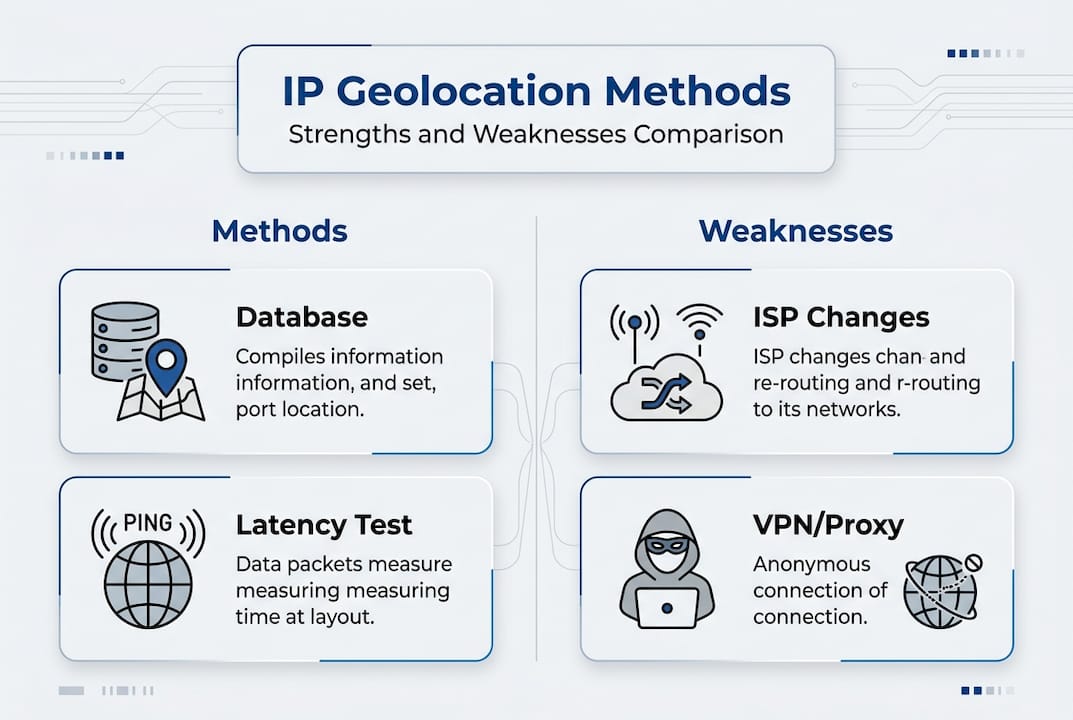
For a detailed breakdown of what to expect from current tools, the IP geolocation accuracy guide covers the key variables in depth.
Pro Tip: For compliance or authentication workflows, never use city-level geolocation as a standalone signal. Pair it with device fingerprinting, behavioural analysis, or multi-factor authentication to reduce false positives.
Applications of IP geolocation in security and privacy
Despite its limitations, IP geolocation remains one of the most practical and widely deployed tools in the security professional's toolkit. The key is knowing where it adds genuine value.
IP geolocation is widely used in cybersecurity for threat detection, content restriction, and privacy diagnostics. Here is how those use cases break down in practice:
- Suspicious login detection. A user account that normally authenticates from Manchester suddenly shows a login attempt from an IP registered in Eastern Europe. That geographic anomaly triggers an alert for your security team to investigate. You can detect suspicious activity automatically using geolocation-aware monitoring tools.
- Content and access restriction. Regulatory compliance often requires that certain data or services are only accessible from specific jurisdictions. Geolocation provides the first filter, though it should not be the only one.
- Privacy diagnostics and leak prevention. IT teams use geolocation to verify that VPNs and proxies are functioning correctly, ensuring that outbound traffic appears to originate from the intended location. Understanding the role of IP addresses in website security is essential here.
- Threat intelligence enrichment. Attaching geographic context to IP addresses in your SIEM or log management platform helps analysts prioritise alerts and spot patterns faster. The cybersecurity IP lookup guide covers how to integrate this into existing workflows.
"Most corporate breaches begin with unchecked remote access, and geolocation is one of the fastest ways to flag anomalous connection origins before damage is done."
The cyber security use cases for geolocation continue to expand as threat actors become more sophisticated. The technology is not a silver bullet, but it is a reliable early-warning layer when used correctly.
Best practices and common pitfalls with IP geolocation
Knowing how geolocation works is only half the battle. Deploying it well requires discipline and an honest assessment of its limits.
- Cross-reference multiple services. A single provider's database may be months out of date. Comparing results across providers surfaces inconsistencies and gives you a more reliable picture. Current IP geolocation accuracy depends heavily on how recently the underlying data was refreshed.
- Do not use city-level data for authentication. City and state errors of 33% to 80% make city-level geolocation unsuitable as a primary authentication signal. Use it as a supporting indicator, not a gate.
- Be transparent with users. If your platform uses geolocation to restrict access or flag accounts, your privacy policy should say so. Users have a right to know when their location is being assessed.
- Account for VPNs, proxies, and corporate networks. These are the most common sources of geolocation errors in enterprise environments. Build logic into your workflows to handle them gracefully rather than blocking legitimate users.
- Update your databases regularly. IP block assignments change constantly. A database that was accurate six months ago may now produce significant errors for large ISPs that have reallocated address ranges.
- Avoid over-relying on geolocation for compliance. Regulators increasingly understand that IP geolocation is probabilistic, not definitive. Supplement it with contractual controls and user declarations where legal certainty is required.
These practices apply whether you are running a small business network or managing security for a large enterprise. The fundamentals do not change with scale.
Discover IP tools for enhanced protection and insight
If you are ready to see the power of IP geolocation in action, these specialised tools make it easy to get started. InstantIPLookup.com brings together everything an IT team needs to investigate, monitor, and act on IP data without switching between multiple platforms.
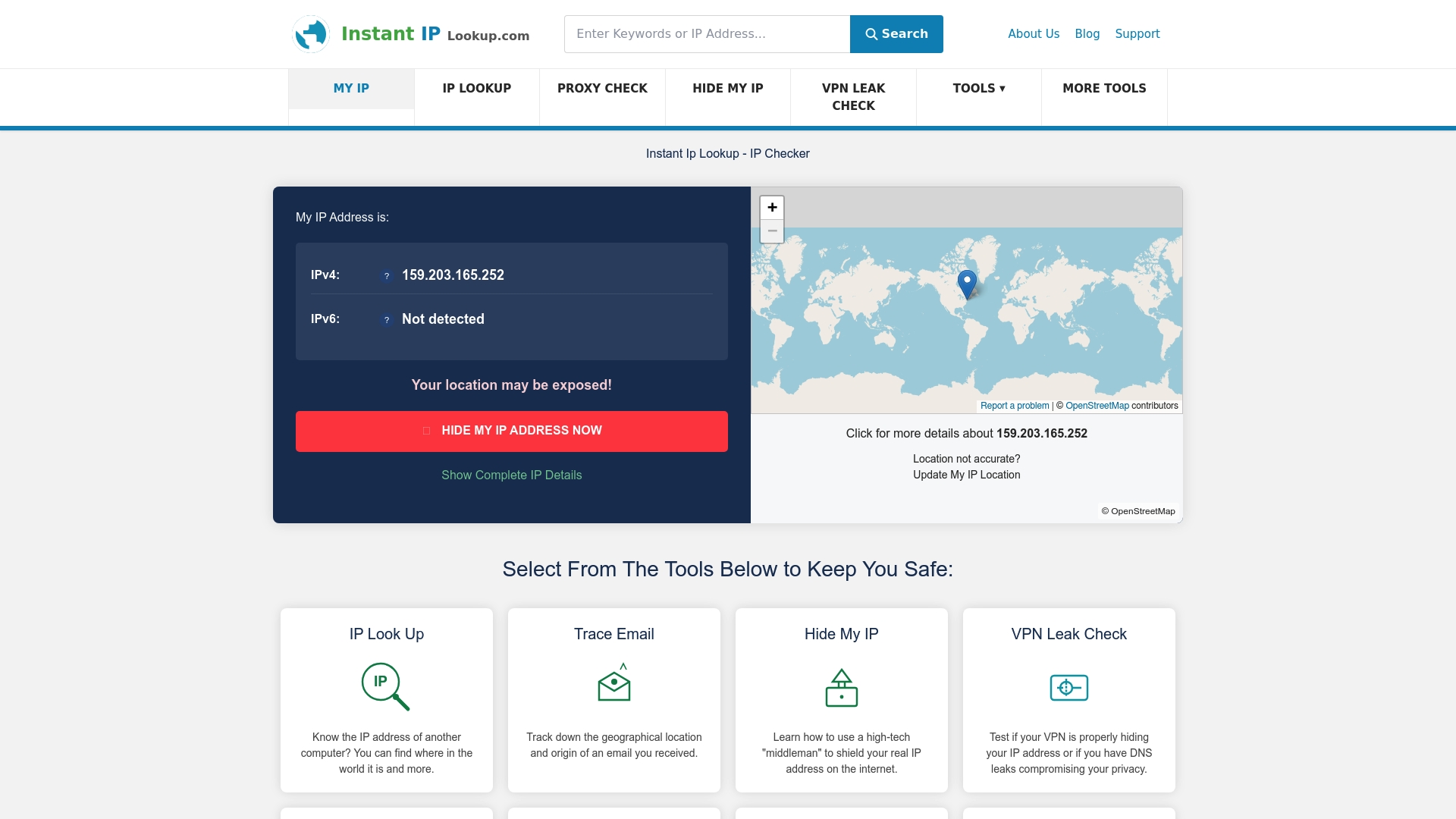
The IP lookup tool gives you instant access to geolocation data, ISP details, proxy and VPN detection, and blacklist status for any address. For teams building geolocation into their security workflows, the cybersecurity IP lookup guide provides a structured framework for integration. And if you want to revisit the fundamentals before going further, the geolocation explained resource covers the core concepts clearly. All tools are available to explore free of charge, with no account required to run your first lookup.
Frequently asked questions
How accurate is IP geolocation at the city level?
City-level accuracy ranges from 33% to 80% depending on the method used and the quality of the underlying data sources. Hybrid approaches that combine latency measurements with registry data tend to perform best.
Why does IP geolocation sometimes get the country wrong?
Database delays, mobile carrier routing, and VPN usage can all cause the registered address to differ significantly from the user's actual physical location, including at the country level.
Can IP geolocation identify a specific user or device?
No. Geolocation maps to the network gateway, not the individual device or person. Shared IP addresses, NAT configurations, and privacy measures all prevent individual identification through IP alone.
What are the main data sources for IP geolocation?
The primary sources are RIRs, ISP geofeeds, WHOIS records, BGP routing tables, latency measurements, and crowdsourced user corrections. Most reliable tools combine all of these.
How can I improve accuracy when using IP geolocation for security?
Consult multiple independent sources and update your geolocation databases frequently. Pairing geolocation with behavioural signals and device data significantly reduces the risk of acting on incorrect location data.
Recommended
- Understanding IP Geolocation: Accuracy, Privacy, And Real-World Uses - Instant Ip Lookup
- What is geolocation accuracy and why it matters in 2026
- Detect Suspicious Activity via IP Geolocation | Instant IP Lookup
- How Accurate Is IP Geolocation, Really? - Instant Ip Lookup
- Physical Security Explained: Complete UK Industry Guide